
Use the youngest child’s needs to decide where play happens
An older sibling's age does not make their toy suitable for a younger child. Check the exact product's age label and warnings, and consider who can reach loose parts during play and afterward. A family with a toddler may need a separate, supervised space for an older child's small-piece project rather than a shared set left on the floor.
The gap between marble-run labels shows why this matters. MAGNA-TILES Rail Racers 33 is labelled 3+, while the standard GraviTrax Starter Set is labelled 8+. Both involve a rolling ball, but that shared idea does not make them equivalent gifts for the same children. We compare their building formats in our Rail Racers versus GraviTrax guide.
For children who are not ready for the same materials, plan shared time around an activity with suitable versions for each: drawing alongside one another, reading together, or building separate projects nearby. The toddler gift guide and guide for ages 6–8 make better starting points than stretching a safety label.
Magnetic tiles give siblings room for separate ideas
The Connetix Pastel Creative Pack has 120 pieces across several square and triangle shapes. Connetix recommends it for ages 3+ and includes both standard and large squares. That variety gives two builders several kinds of structure to attempt; it does not establish how many complete buildings they can make at once.
Look at the inventory in terms of likely use. Two children both building enclosed houses may compete for squares even when plenty of triangles remain. Spreading out the pieces before play can reveal that constraint sooner than dividing them into equal piles by number. An equal count is not necessarily an equally useful collection.
Our suggested starting activity is to give each child a small building area and agree on one connection—a road, a bridge or a shared courtyard. They can work independently without one project having to wait for the other. Later, try one larger structure if both want to. The magnetic tile activity guide offers starting points, and tiles versus wooden blocks considers the broader choice.

A marble run is easier to share when the jobs rotate
Rail Racers 33 adds a route-building task: create the track, release the ball, then work out what to change. Its magnetic rails connect without separate connectors, according to MAGNA-TILES. If the family already owns suitable MAGNA-TILES pieces, check the manufacturer's compatibility information before deciding how the set will extend their collection.
Give the first builder and first tester different jobs, then swap. The tester can describe where the ball stopped while the builder makes one change. Avoid turning “tester” into the permanent job of the younger child; building is part of the appeal too.
This is a suggested way to organize play, not a finding that the set prevents arguments or teaches a particular skill. If both children mainly want to release the ball, a simple turn order may help more than additional track. If both want to design, enough space for two short routes may matter more than the largest advertised construction.

Choose a cooperative game for the whole group
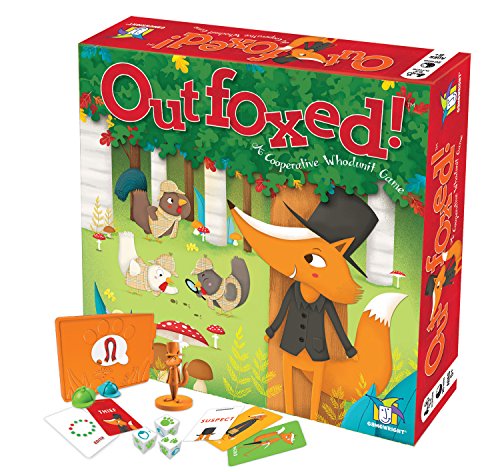
A cooperative game puts the players on the same side, but still asks them to listen and make choices together. Outfoxed is a useful option to examine for younger families: Gamewright lists ages 5+, two to four players and about 20 minutes. Players gather clues and narrow down suspects. For older children, Forbidden Desert has a longer shared survival problem; its publisher lists ages 10+, two to five players and about 45 minutes.
The older child's experience matters as well as the younger child's entry point. A simple game can become enjoyable through discussion, but nobody should have to pretend not to understand it. Equally, helping a younger child through every decision in a more demanding game may leave that child with little ownership. Our comparison of the two games explains when each is the more practical choice.
During a cooperative game, try asking the active player what they want to do before offering suggestions. Having one team does not mean having one person supply all the answers.

Plan storage and ownership before wrapping
Decide whether the present belongs to both children, to the family, or to one child who may invite the other to play. Those arrangements can all work, but they should not be confused. A shared label should not become an obligation for one child to hand over a personal present whenever asked.
For a building set, choose a storage place both permitted users can manage, while keeping small pieces away from younger children. For a game, keep the components together so the next session can begin without a search for missing cards. Our small-space toy rotation guide can help if the shared gift needs a clear surface that is also used for meals or homework.
A small personal addition—a drawing pad, a book, or a note naming each child's role in choosing the first activity—can acknowledge that the shared gift is for two different people. The important part is to offer participation, rather than promise that sharing will happen automatically.
Sources & approach
Reviewed . Sources below support the specifications and guidance cited in this article. Recommendations and suggested activities are editorial judgments. We have not tested the products hands-on; source or model limitations are identified in the text.
- Connetix: Pastel Creative Pack 120 Pieces (opens in a new tab)
- MAGNA-TILES: Rail Racers 33-Piece Set (opens in a new tab)
- Ravensburger: GraviTrax Starter Set 22410 (opens in a new tab)
- Gamewright: Outfoxed (opens in a new tab)
- Gamewright: Forbidden Desert (opens in a new tab)
Manufacturer ages, contents and player counts checked October 22, 2026. Suggested ways to share are editorial ideas, not tested outcomes or guarantees about sibling behavior.
Before buying or using a product, follow the exact model’s age label, warnings, and instructions. Check current US recalls (opens in a new tab), or your local recall authority outside the US.
Keep exploring: Gifts that fit their interests