
How DUPLO and LEGO bricks differ
DUPLO is LEGO at double scale. According to LEGO, DUPLO bricks are twice the size of standard LEGO bricks in every dimension; the name comes from the Latin duplex, “double,” and the first DUPLO sets went on sale in 1969. LEGO says its research found the larger size suits younger builders, and it makes DUPLO sets for children from 18 months.
Standard LEGO bricks, the kind used in LEGO Classic, City, and most other ranges, are meant for children of 4 and older, and they come with a warning. The Classic Medium Creative Brick Box 10696, for instance, is labeled 4–99 and carries a choking-hazard warning: small parts, not for children under 3. That line is a legal one as well as a practical one, since federal rules ban small parts in toys intended for children under 3.
The right system is the one that fits the child in front of you and, in a house with more than one child, the youngest child who can reach the bricks.
What age is DUPLO for?
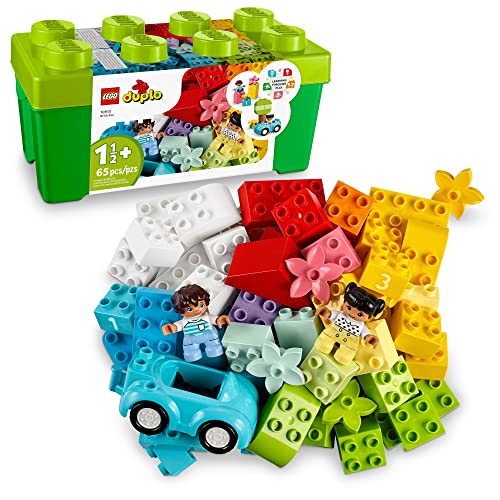
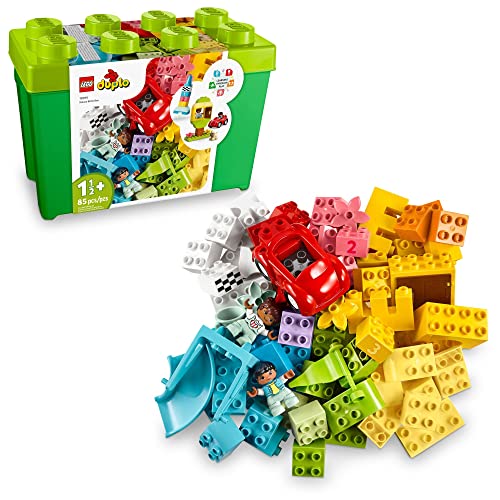
LEGO describes DUPLO as made for children aged 18 months and up. Most DUPLO boxes are labeled 1½+ or 2+, and a few are labeled 3+. The DUPLO Brick Box 10913 is a typical first box: LEGO lists it for ages 1½ and up, with 65 pieces, two DUPLO figures, a car, number bricks, and a storage box, plus a booklet of easy models. The Deluxe Brick Box 10914 is the bigger version, with 85 pieces.
There is no age at which a child has to stop. LEGO’s own advice is to wait if a child still prefers DUPLO, and DUPLO remains the right system for any child under 3 in the house.
When to switch from DUPLO to LEGO
LEGO’s guide to moving from DUPLO to LEGO bricks is firm about the earliest point: four is the youngest age at which the company would advise introducing standard bricks. Beyond that, it suggests watching for signs of readiness rather than a birthday:
- The child attaches and pulls apart DUPLO bricks easily.
- Their attention span has grown.
- They notice finer detail or build more elaborate ideas.
Watch the whole session, not just the finished model. Small bricks mean more searching, more careful lining up, and more pulling apart at the end. A child who enjoys that part is probably ready. A child who wants a wall up quickly so the story can start may be happier with DUPLO for a while yet, and that preference says nothing about how capable they are.
Best first LEGO sets after DUPLO
Start small. LEGO suggests a first set labeled 4+ with fewer than 100 pieces. Such sets split the bricks into numbered bags, use illustrated instructions, and usually come with decorated pieces instead of stickers. Some include a LEGO Starter Brick, an element designed to give new builders a head start.
A small themed set
The LEGO City Fire Ladder Truck 60463 fits that description closely: 82 pieces, a Starter Brick, a pictorial guide, and two firefighter minifigures, labeled 4+. A familiar subject gives the build an obvious reward, because there is a truck to play with at the end.
A small creative set
LEGO Classic Creative Food Friends 11039 is a step toward free building. Its 150 pieces make four small food characters that can be rebuilt into four more, and then into whatever the child invents. That is more than LEGO’s suggested 100 pieces, but LEGO describes the models as quick to build.
A brick box, a little later
A big box of loose bricks makes a better second set than a first. With hundreds of pieces and no single model to finish, it asks a new builder to search and plan far more than a small set does.


DUPLO Brick Box vs. LEGO Classic brick box
On paper these look like rival first sets, but they belong to different ages:
| Detail | DUPLO Brick Box 10913 | Classic Medium Creative Brick Box 10696 |
|---|---|---|
| Age label | 1½+ | 4–99 |
| Pieces | 65 | 484 |
| Figures | 2 DUPLO figures | None listed; eyes for brick-built creatures |
| Special pieces | A car and 1, 2, and 3 number bricks | Windows, 18 tires and wheel rims, and a green baseplate |
| Ideas | Booklet of easy models | Building ideas included |
| Storage | Storage box | Plastic storage box |
| Warning | None shown on LEGO’s page | Choking hazard: small parts, not for children under 3 |
Sources: LEGO’s US pages for 10913 and 10696.
The Classic Medium Creative Brick Box leans toward vehicles: it has 18 tires and wheel rims, while the larger 790-piece Classic box has six. That makes it a good match for a child who wants to build cars and trucks, and a good companion to a small themed set once standard bricks are in play.

Do DUPLO and LEGO bricks fit together?
Some of them do. According to LEGO’s help page, standard 2×2 and 2×4 bricks fit DUPLO bricks, but 1×2 and 2×3 bricks don’t. Standard bricks also attach on top of DUPLO bricks that have hollow studs. Figures don’t cross over: DUPLO figures don’t fit standard LEGO bricks, and minifigures don’t fit DUPLO.
That partial fit is deliberate. In LEGO’s account of DUPLO’s history, Godtfred Kirk Christiansen, the company’s second-generation owner, came up with hollow studs on DUPLO bricks in 1968 so the two systems could be combined. In practice, an older child can add small-brick details to a DUPLO build, and a DUPLO base can anchor a joint project, as long as an adult decides which small pieces are in play.
Keeping DUPLO and LEGO in a house with a toddler
The fact that some bricks connect doesn’t make small pieces safe for small children. If a child under 3 shares the play space, keep standard LEGO in its own container, apart from the shared DUPLO tub, and use it at a table out of the toddler’s reach. A case with compartments helps an older child find pieces and put them back: the LEGO Classic Creative Suitcase 10713 is a 213-piece set, labeled 4–99, that comes in a yellow case with sorting compartments.
There’s no need to clear out the DUPLO when standard bricks arrive. A child can use both, picking big bricks for fast building and long pretend games and small ones for detailed models. Once you have settled the brick system, the next decision is what kind of set to buy; our guide to themed LEGO sets and brick boxes covers it, our LEGO sets by age guide suggests sets from 4 to 12, and the full range is on our LEGO page.

Sources & approach
Reviewed . Sources below support the specifications and guidance cited in this article. Recommendations and suggested activities are editorial judgments. We have not tested the products hands-on; source or model limitations are identified in the text.
- LEGO: Transitioning your child from LEGO DUPLO to LEGO bricks (opens in a new tab)
- LEGO help: Building with LEGO and DUPLO bricks (opens in a new tab)
- LEGO help: Comparing LEGO bricks, plates, and DUPLO bricks (opens in a new tab)
- LEGO Group: 50 years young (DUPLO history, January 2019) (opens in a new tab)
- LEGO DUPLO Brick Box 10913 (opens in a new tab)
- LEGO DUPLO Deluxe Brick Box 10914 (opens in a new tab)
- LEGO Classic Medium Creative Brick Box 10696 (opens in a new tab)
- LEGO Classic Large Creative Brick Box 10698 (opens in a new tab)
- LEGO City Fire Ladder Truck 60463 (opens in a new tab)
- LEGO Classic Creative Food Friends 11039 (opens in a new tab)
- LEGO Classic Creative Suitcase 10713 (opens in a new tab)
- CPSC: Small parts for toys and children’s products (opens in a new tab)
Rewritten October 19, 2026. Age labels, piece counts, compatibility, and LEGO’s transition advice were rechecked against LEGO’s US pages; the advice on choosing between them is our own.
Before buying or using a product, follow the exact model’s age label, warnings, and instructions. Check current US recalls (opens in a new tab), or your local recall authority outside the US.
Keep exploring: Building toys & first games · LEGO collection