
The main difference
Magnetic tiles connect; wooden blocks balance. Nearly everything else follows from that. Magnets hold tile edges together, so a wall can stand on one thin edge and a roof can close over a room. A block stays put only while something underneath supports it, so balance is the whole game: towers, bridges, ramps, and roads that run across the floor.
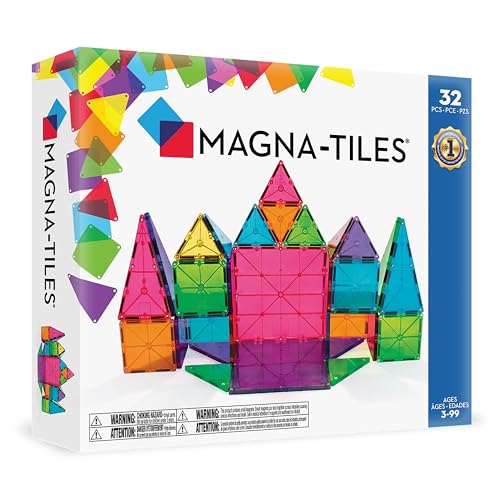
Both are open-ended building toys, and both reward planning and trial and error. The more useful question is which one your child will keep coming back to. A child who makes rooms and homes for toy animals is enclosing space, which tiles do quickly. A child who stacks towers to knock them down, or lines up a road for cars, is working with balance and length, which is what blocks are for. This guide uses the MAGNA-TILES Classic 32 and two Melissa & Doug block sets as examples, with details from the makers’ own pages.
Looking for wooden blocks that also connect magnetically? Our Tegu magnetic wooden blocks guide compares that different format, including the 14-piece set and Pocket Pouches.
Magnetic tiles vs. wooden blocks at a glance
| Question | Magnetic tiles | Wooden blocks |
|---|---|---|
| How do pieces hold together? | Magnets along the edges | Weight and balance |
| Typical builds | Rooms, boxes, roofs, and 3D shapes | Towers, bridges, ramps, and roads |
| Age label on our examples | 3 and up (MAGNA-TILES Classic 32) | 2 and up (both Melissa & Doug sets) |
| Piece size | 3-inch base measurement | About 1 to 2¼ inches in the 100-block set; larger in the unit-block set |
| What to check when tidying | Cracks, split seams, loose or missing magnets | Cracks, splinters, and rough edges |
Sources: MAGNA-TILES Classic 32 and the company’s FAQ; Melissa & Doug’s 100-block and unit-block pages.
What magnetic tiles are good for
Tiles are quick. Four squares stood in a ring already make a room, ready for a roof, a door, or a second story. That speed suits a child who wants a setting for a story, such as a stable for toy horses, a garage, or a house for a favorite figure. The shapes also lead naturally to geometry: six squares make a cube, and four equilateral triangles on a square make a pyramid. And because the Classic tiles are translucent colored plastic, a build on a sunny windowsill throws colored light across the floor, something no wooden block can do.
The trade-offs are cost and age. Magnetic tiles cost far more per piece than small wooden blocks, and MAGNA-TILES labels the Classic sets for ages 3 and up. A small set also runs short of squares quickly; our Classic 32 guide works through what 32 tiles can and can’t build.
What wooden blocks are good for
Blocks reward patience with balance. A tower stands or falls on how well each piece sits on the one below; a bridge needs two supports of the same height and a piece long enough to span the gap; a ramp raises the question of how steep is too steep. Blocks have been basic equipment in early childhood classrooms for more than a century. In a 2015 roundup for NAEYC’s journal Young Children, contributors named length, measurement, comparison, number, estimation, symmetry, and balance among the math ideas children practice with blocks, along with spatial sense and problem solving.
Wooden blocks come in two main styles. Small colored sets such as the Melissa & Doug 100 Wooden Building Blocks hold 100 solid wood blocks in four colors and nine shapes, each roughly 1 to 2¼ inches long, at a modest price. Unit blocks are larger, plain hardwood blocks. According to a National Science Teaching Association blog post, they have been a staple of early childhood classrooms since the educator Caroline Pratt designed them in 1913. The system is built on a single block with proportions of 1:2:4, and the other shapes are based on that unit. The Melissa & Doug Standard Unit Blocks set has 60 natural-finish hardwood blocks that store in a wooden tray.


Which is better for toddlers?
For a child under 3, wooden blocks are the age-appropriate choice. MAGNA-TILES labels the Classic sets for ages 3 and up, and its FAQ recommends active adult supervision for young children who may put pieces in their mouths. Both Melissa & Doug sets carry a 2+ label, although the description of the 100-block set also mentions builders “three and older,” so check the age on the box you buy. For children under 2, look for blocks labeled for their age; our baby and toddler collection is a starting point.
From 3, either format works, and the choice goes back to how the child plays. Whichever you buy, look it over as you tidy. The CPSC tells parents to stop using a toy immediately if a magnet has come loose or gone missing. With wooden blocks, set aside any piece that has cracked or started to splinter.
How many pieces do you need?
Piece counts don’t translate between formats. One magnetic square can be an entire wall, while a small block is closer to a single brick in that wall. A hundred blocks and a hundred tiles build very different amounts of house, so compare what a set can make rather than the number on the box.
For tiles, count the standard squares, because they make walls and floors and run out first: the Classic 32 has 14 and the Classic 100 has 50, according to MAGNA-TILES. For blocks, look for matching sizes. Bridges and archways need pairs of supports of the same height, and a tall tower needs enough large pieces for a wide base. A small colored set gives you plenty of pieces but tops out at about 2¼ inches, while unit blocks are bigger, which suits larger structures and long floor roads.
Can you use tiles and blocks together?
Yes, and if you already own one kind, adding the other can make both more useful. A tile laid across two block towers becomes a roof or a bridge deck; blocks can furnish a tile room or edge a tile garden. The magnets won’t grip wood, so a tile roof on blocks simply rests in place, and the whole build becomes a balancing project again.
Which to buy
- Choose magnetic tiles for a child of 3 or older who likes rooms, houses, and settings for figures, or who enjoys shapes and color. Start with a Classic set and add squares when walls run short.
- Choose wooden blocks for a toddler, for a child who builds towers to knock them down, or for anyone who loves roads and ramps. A small colored set is an inexpensive start; unit blocks cost more but are bigger and closer to what many preschool classrooms use.
- Think about space. Tiles stack flat in a shallow bin. Unit blocks need a shelf or their tray, and a block city takes up floor space for as long as it stands.
Whichever you choose, our magnetic tile building ideas and the building sets collection are good next stops.
Sources & approach
Reviewed . Sources below support the specifications and guidance cited in this article. Recommendations and suggested activities are editorial judgments. We have not tested the products hands-on; source or model limitations are identified in the text.
- MAGNA-TILES: Classic 32-Piece Set (contents and ages) (opens in a new tab)
- MAGNA-TILES: Frequently asked questions (size, supervision) (opens in a new tab)
- MAGNA-TILES: Classic 100-Piece Set (contents) (opens in a new tab)
- Melissa & Doug: 100-Piece Wood Blocks Set (opens in a new tab)
- Melissa & Doug: Standard Unit Blocks (60 pieces) (opens in a new tab)
- NAEYC, Young Children (March 2015): Ten things children learn from block play (opens in a new tab)
- NSTA blog: Building with blocks, building skills and memories (opens in a new tab)
- CPSC: Child safety (magnetic toys) (opens in a new tab)
Rewritten October 19, 2026. Contents and age labels were rechecked against the makers’ pages; the Melissa & Doug 100-block page still gives both 2+ and three-and-older guidance, which the article notes.
Before buying or using a product, follow the exact model’s age label, warnings, and instructions. Check current US recalls (opens in a new tab), or your local recall authority outside the US.
Keep exploring: Building toys & first games