
How Yoto and Toniebox work
Both players solve the same problem: they let a child choose and play stories, songs and podcasts without a screen or a parent’s phone. The difference is in the hand. On a Toniebox, the child sets a figure, called a Tonie, on top of a soft cube, and playback starts; pressing the ears changes the volume, and Tonies says children tap, tilt or squeeze the box to navigate. On a Yoto, the child pushes a card into a slot to play and pulls it out to stop, with dials for volume and tracks.
That physical difference matters more than most specifications. A Tonie is a toy in its own right, easy for a small hand to place and to hold. A card is flat and easy to file by the dozen, which suits a growing audiobook library and a backpack.
The new Yoto players add a third way in. Their Green Button, which Yoto describes as twist to browse and press to play, opens two playlists of up to 20 titles each, one for the day and one for the night, which a parent sets in the Yoto app. A child can reach a favorite story without hunting for its card.
Which models are on sale in 2026?
Both lineups changed this year. Tonies introduced the Toniebox Lite on July 27, 2026: a smaller, lighter box with a hard shell, certified for children from age 1 and compatible with every Tonie ever released. It drops the Toniebox 2’s light ring, sunrise alarm and Tonieplay games, and its product page lists the USB-C cable as sold separately. The Toniebox 2, which reached the United States in October 2025, remains the flagship, and Tonies has said the original Toniebox stays fully functional with the same figures.
Yoto announced its 4th Gen Player and 4th Gen Mini on September 10, 2026, and set estimated shipping dates of September 30 for the Mini and October 15 for the Player. Both double the storage of the previous models and add the Green Button; the Mini is now water- and dust-resistant to IP67, and the Player charges wirelessly as well as by USB-C. Yoto still sells the Mini 2024 Edition, and we carry the 2024 Mini and the 3rd Gen Player.
| Player | Stated ages | Battery life | Offline storage | Bedtime features |
|---|---|---|---|---|
| Toniebox 2 | 1 to 12+ | Not stated; a full charge takes at least 3 hours | Not stated | Light ring that doubles as a night light, sleep timer, sunrise alarm |
| Toniebox Lite (new) | 1 to 12+ | Not stated | Not stated | Sleep timer; no light ring or alarm |
| Yoto Player 4th Gen (new) | 3+ | Up to 16 hours | 64GB, 1,000+ hours | Full-panel night light, OK-to-wake clock |
| Yoto Mini 4th Gen (new) | 3+ | Up to 16 hours | 64GB, 1,000+ hours | Clock display; no full-panel night light |
| Yoto Player 3rd Gen | 3 to 12+ | Up to 16 hours | 32GB, 600+ hours | Night light, OK-to-wake clock |
| Yoto Mini 2024 Edition | 3+ | Up to 14 hours | 32GB, 500+ hours | OK-to-wake clock; no night light |
These are the makers’ figures, not our measurements, and battery life in particular depends on volume and use. Tonies’ pages give charging details rather than a running time.
Which is better for a toddler?
For a child under three, the Toniebox is the clearer choice. Tonies certifies both the Toniebox 2 and the Toniebox Lite for ages 1 and up, and the starter set’s short USB-C cable is sized, Tonies says, to meet child safety standards for listeners from age 1. Yoto rates its players for ages 3 and up and says on its Player page that younger children can listen while a caregiver handles the device.
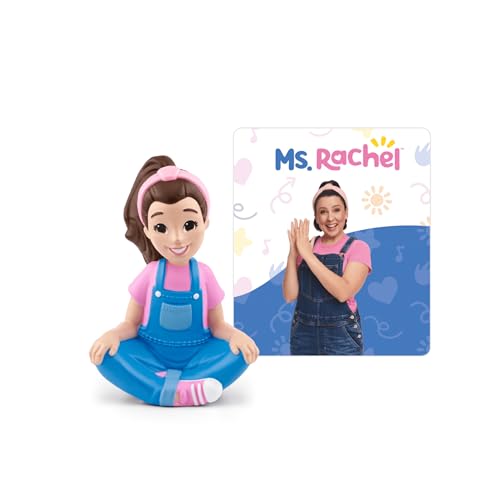
The figures need the same attention as the box. Tonies’ own age guide points one- and two-year-olds toward My First Tonies and Sleepy Friends and places Classic Tonies at 3 and up; its blank Creative-Tonies carry a warning that they are not for children under 36 months. My First Tonies, launched with the Toniebox 2, are soft, squeezable figures that Tonies designed for ages 1 and up, sold in farm, travel and jungle sets with real-world sounds and toddler songs. Check the label on each figure you buy; the Ms. Rachel Tonie, for example, lists a recommended age of 1 and up.

Which is better for audiobooks and older kids?
Both makers pitch their players at children up to 12 and beyond, so the real question is the shape of the library. Yoto’s catalog runs to more than a thousand titles from publishers including Penguin Random House, the Roald Dahl Story Company and the BBC, according to its launch announcement, and the players come with the free Yoto Daily podcast and Yoto Radio. Long listens are easy to find: the Magic Tree House collection holds eight audiobooks read by Mary Pope Osborne, nearly six hours in all.
Tonies’ answer for older children is Book Tonies and Pocket Tonies, which its age guide recommends from about age 5 or 6, alongside Tonieplay games for ages 3 to 7 and up. Tonies says its library now holds more than 1,500 figures and more than 3,500 digital titles. For a child who wants whole novels, compare the two catalogs for the specific series they read.
One more point favors Yoto for the school years: cards fit in a pocket, and the Mini fits in a bag. A Toniebox travels too, but its figures are bulkier to pack.


What the stories cost over time
The player is a one-time purchase; the library is where the money goes. On a Toniebox, each figure carries its own content, so a new story usually means a new Tonie. Creative-Tonies are the exception: you upload or record up to 90 minutes of your own audio, from bedtime songs to a grandparent reading aloud. Yoto sells physical cards and packs, adds free podcasts and radio, and lets you put almost any audio on a Make Your Own card. Its optional membership, Yoto Club, discounts cards through credits that expire 12 months after they are issued.
Before you choose, list the stories and songs your child already loves and check which library carries them. We stock Toy Story’s Woody as a Tonie, for example, and Daniel Tiger’s sleepy stories as a Yoto card. Relatives who want to give something small can then add to the collection instead of guessing.
Yoto 4th Gen or last year’s model?
The 4th Gen players bring real improvements: twice the storage, the Green Button, wireless charging on the Player and water resistance on the Mini, whose stated battery life rises from 14 to 16 hours. Yoto also gives both a two-year warranty. There is one catch for now. Yoto says almost all cards work with the new players, but interactive cards are “coming soon,” and a few features are not yet available on the new platform.
The previous models remain capable. The Yoto Player (3rd Gen) has the same stated 16-hour battery, a night light, an OK-to-wake clock and a room thermometer, and the Yoto Mini (2024 Edition) still suits travel, though without the new water resistance. Almost all cards bought for either will play on the new models, so starting with an older player does not strand a library.
On the Tonies side, the Toniebox 2 is worth its premium if you want the bedtime light, the sunrise alarm or Tonieplay games; the Lite covers the listening for less and is smaller to carry. An original Toniebox, which Tonies says remains fully functional, still plays its figures.


Safety, privacy and secondhand players
Neither brand puts a screen in front of a child. Yoto states that the Mini 2024 Edition has no microphone, no camera and no ads, and Tonies’ app lets parents set a maximum volume. Yoto’s 4th Gen players apply volume limits to wired and Bluetooth headphones by default.
If you are handed down an older Yoto, check it. The original Yoto Mini, sold from November 2021 through April 2024, was recalled because its lithium-ion battery can overheat and catch fire; in December 2024 the Consumer Product Safety Commission reannounced the recall with a free battery replacement kit. The model details are printed on the base, and the notice explains how to request the kit from Yoto.
Which to buy
Choose a Toniebox 2 for a child under three, or for a child who treats the figures as toys; choose the Lite if you want the same figures in a smaller, simpler box and can live without the bedtime light. Choose a Yoto for a child of five or older who is ready for audiobooks and podcasts: the Player for a bedroom, with its night light, and the Mini for travel. Between three and five either works, so let the library decide: the right player is the one whose stories your child will keep asking for.
Either player works best alongside shared books rather than instead of them. Our read-aloud routine guide has ideas for fitting audio into the day, and the listening collection holds the figures and cards we stock.
Sources & approach
Reviewed . Sources below support the specifications and guidance cited in this article. Recommendations and suggested activities are editorial judgments. We have not tested the products hands-on; source or model limitations are identified in the text.
- Yoto: Yoto Player 4th Gen (opens in a new tab)
- Yoto: Yoto Mini 4th Gen (opens in a new tab)
- Yoto: Yoto Mini (2024 Edition) (opens in a new tab)
- Yoto press release: Yoto launches Yoto Player 4th Gen and Yoto Mini 4th Gen (Sept. 10, 2026) (opens in a new tab)
- Yoto: Yoto Club (opens in a new tab)
- tonies: Tonieboxes, how they work (opens in a new tab)
- tonies: Toniebox Lite (opens in a new tab)
- tonies: Toniebox Lite announcement (July 27, 2026) (opens in a new tab)
- tonies: Toniebox 2, Tonieplay and My First Tonies announcement (PR Newswire, Aug. 27, 2025) (opens in a new tab)
- tonies: Guide to Toniebox 2 and Tonies by age (opens in a new tab)
- tonies: Wizard Creative-Tonie (opens in a new tab)
- CPSC: Yoto reannounces recall of Yoto Mini speakers (Dec. 12, 2024) (opens in a new tab)
Rewritten October 19, 2026, to cover the Yoto 4th Gen players and the Toniebox Lite. A research-based comparison of the makers’ specifications and age guidance; we have not tested these players.
Before buying or using a product, follow the exact model’s age label, warnings, and instructions. Check current US recalls (opens in a new tab), or your local recall authority outside the US.
Keep exploring: Books & early learning